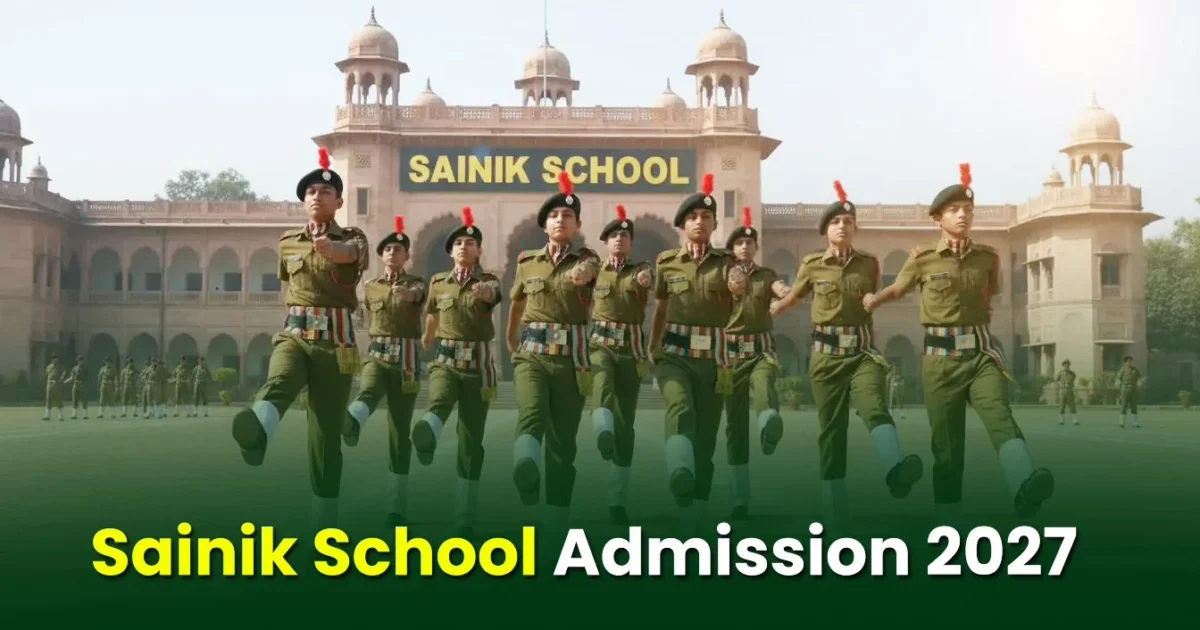
Sainik School Admission 2027 : Class VI and IX Entrance Exam
Quick Summary — AISSEE 2027 admission
| Organization | National Testing Agency (NTA); Sainik Schools Society |
|---|---|
| Eligibility | For Class IX in existing Sainik Schools and the New Sainik Schools 40% route, candidates must pass Class VIII from a recognised school by admission. Additional current-school requirements apply to the 60% route. |
| Admission Mode | Online only |
| Last Date | 6 December 2026 for late submission with a ₹500 late fee; the regular deadline is 2 December 2026. |
Short Introduction
AISSEE 2027 admission covers Class VI and Class IX entry to Sainik Schools and eligible approved New Sainik Schools for the 2027–28 academic year. The National Testing Agency will conduct the entrance examination on 31 January 2027.
Notification Overview
| Location | Sainik Schools and approved New Sainik Schools in India |
|---|
Important Dates
| Event | Date |
|---|---|
| Regular online application period | 3 November 2026 to 2 December 2026, up to 11:50 pm |
| Regular fee payment deadline | 2 December 2026, up to 11:50 pm |
| Late application period with ₹500 late fee | 3 December 2026 to 6 December 2026 |
| Late fee transaction deadline | 6 December 2026, up to 11:50 pm |
| Online application correction window | 7 December 2026 to 9 December 2026, up to 11:50 pm |
| Advance city intimation slip | 11 January 2027 |
| Admit card download | 25 January 2027 |
| AISSEE examination | 31 January 2027 |
Admission / Application Fee
| Category | Examination fee |
|---|---|
| General, Central List OBC-NCL and wards of defence personnel and ex-servicemen | ₹850 |
| Scheduled Caste and Scheduled Tribe | ₹700 |
Age Limit
- Class VI: Candidates must be 10–12 years old as on 31 March 2027 and born between 1 April 2015 and 31 March 2017, both dates inclusive.
- Class IX: Candidates must be 13–15 years old as on 31 March 2027 and born between 1 April 2012 and 31 March 2014, both dates inclusive.
- The same age criteria apply to boys and girls and to both New Sainik School routes.
Eligibility Details
- AISSEE covers Classes VI and IX at 33 existing Sainik Schools, Class VI at 80 approved New Sainik Schools and Class IX at 40 approved New Sainik Schools that have progressed to that class in 2027–28.
- Boys and girls may apply.
- Girls’ Class IX admission is subject to vacancies;
- applicants should check each approved New Sainik School’s policy and available seats.
- For approved New Sainik Schools, the 40% route is open to eligible candidates;
- the 60% route is restricted to eligible students already studying at the same school.
- New Sainik School Class IX entry is limited to schools that have completed Class VIII in the Sainik School vertical and to the relevant route’s unfilled initial Class VI vacancies and subsequent withdrawals.
- Admission to an approved New Sainik School does not give a student a right to admission or transfer to an existing Sainik School.
Admission Process
- Appear in the AISSEE paper-based entrance examination.
- NTA prepares the applicable merit lists from examination marks.
- Eligible candidates re-register and participate in e-counselling for school allotment.
- Admission remains subject to available seats, applicable eligibility, medical fitness and verification of original documents.
Tentative Admission Seats
- Seat availability differs by school, class, gender, domicile and category and is subject to revision.
- The published existing Sainik School Class IX list states 731 tentative seats: 440 boys’ Home State, 222 boys’ Other State, 35 girls’ Home State and 34 girls’ Other State seats.
- Existing Sainik School seats may change when cadets withdraw or transfer and may be redistributed under the reservation rules.
- Approved New Sainik School seat lists identify boys’, girls’ and gender-neutral seats.
- New vacancies may be redistributed between the 40% and 60% routes.
- Candidates may choose a school even where their category currently has no listed vacancy;
- a vacancy may arise later.
- Registration does not guarantee a seat in that category.
- School fees, board, language of instruction and residential facilities can differ between approved New Sainik Schools.
Educational Requirements
- For Class IX in an existing Sainik School or the approved New Sainik School 40% route, the candidate must have passed Class VIII from a recognised school at the time of admission.
- For the approved New Sainik School 60% route to Class VI, the candidate must be studying at the school where admission is sought and have passed or be appearing in Class V as on 31 March 2027.
- For the approved New Sainik School 60% route to Class IX, the candidate must be studying at the school where admission is sought and have passed or be appearing in Class VIII as on 31 March 2027.
Fee Conditions
- A ₹500 late fee applies to applications submitted during the late submission period.
- The same examination fee applies whether the candidate seeks an existing Sainik School, an approved New Sainik School or both.
- Applicable bank or payment service charges and taxes are additional.
- The examination fee is non-refundable and cannot be carried forward to a future examination.
- If a transaction is cancelled and the confirmation page is not generated, the candidate must pay again.
- A cancelled card transaction is automatically refunded after the application deadline or fee reconciliation.
Qualifying Marks
- Existing Sainik Schools: General, OBC-NCL and Defence/ex-servicemen candidates need at least 25% in each subject and 40% overall.
- Existing Sainik Schools: No minimum marks are prescribed for SC/ST candidates;
- admission is based on inter-se merit within their categories and the other admission conditions.
- Approved New Sainik Schools: Every candidate, including SC/ST candidates, needs at least 25% in each subject and 40% overall.
- An SC, ST or OBC-NCL candidate who qualifies on their own in general merit is admitted against a general seat rather than the reserved share.
Admission Routes and Merit
- Existing Sainik School merit lists are prepared by school, class, gender, category and Home State or Other State quota.
- Approved New Sainik Schools fill at least 40% of Sainik School stream seats through the All India Merit List and may fill up to 60% through a school-wise list of eligible students already enrolled in that school.
- Unfilled seats in the 60% route may be filled from qualifying 40% route candidates.
- An allotted school that a candidate does not accept will not be offered to that candidate in future counselling sessions.
- Passing the examination or appearing on a waiting list does not guarantee admission.
- The result is valid only for Class VI or IX admission in the 2027–28 academic year.
Reservation in Existing Sainik Schools
- Home State or Union Territory candidates receive 67% of seats;
- candidates from other States and Union Territories receive 33%.
- Home State is determined by comparing the candidate’s domicile with the location of the chosen school.
- Within each domicile quota, 15% is reserved for SC, 7.5% for ST and 27% for Central List OBC-NCL candidates.
- Of the remaining 50.5% within each domicile quota, 25% is reserved for wards of serving Indian Army, Indian Navy and Indian Air Force personnel and ex-servicemen.
- In the Other State quota, a single State or Union Territory is limited to 25% of vacancies across all categories, with rounding as illustrated in the reservation rules.
- For Class VI girls, one seat per category is allotted and 10% of the class strength or 10 seats, whichever is higher, is reserved for girls.
- If an SC, ST or OBC-NCL category is unavailable within the Home State or Union Territory, its seats are distributed among available Home State categories so the 67% quota remains with that domicile group.
- OBC-NCL candidates must be in the Central List as applicable on the first day of the month in which applications begin and meet the income criteria.
- State-list-only OBC candidates must select General or Unreserved, not OBC-NCL.
- Wards of Coast Guard and Assam Rifles personnel should select the applicable SC, ST, OBC-NCL or General category, not Defence.
- They may be considered for Defence vacancies only after wards of serving and ex-service defence personnel;
- they are not entitled to a Defence scholarship.
- Approved New Sainik School domicile, category and reservation requirements are set by the respective school management and declared with its vacancies.
AISSEE Exam Pattern
| Class and subject | Questions | Marks per correct answer | Total marks |
|---|---|---|---|
| VI: Language | 25 | 2 | 50 |
| VI: Mathematics | 50 | 3 | 150 |
| VI: Intelligence | 25 | 2 | 50 |
| VI: General Knowledge | 25 | 2 | 50 |
| VI total | 125 | 300 | |
| IX: Mathematics | 50 | 4 | 200 |
| IX: Intelligence | 25 | 2 | 50 |
| IX: English | 25 | 2 | 50 |
| IX: General Science | 25 | 2 | 50 |
| IX: Social Science | 25 | 2 | 50 |
| IX total | 150 | 400 |
Exam Rules and Medium
- Both papers use multiple-choice questions on paper and OMR answer sheets.
- There is no negative marking for a wrong answer.
- On 31 January 2027, Class VI runs from 2:00 pm to 4:30 pm for 150 minutes;
- Class IX runs from 2:00 pm to 5:00 pm for 180 minutes.
- Class IX is in English only.
- Class VI is available in English, Hindi, Gujarati, Malayalam, Marathi, Assamese, Telugu, Odia, Punjabi, Kannada, Bengali, Tamil and Urdu.
- A Class VI candidate may select any listed language regardless of the school chosen.
- The selected medium cannot be changed.
- English or Hindi choices receive an English-Hindi bilingual booklet.
- A regional-language choice receives a booklet in that language and English.
- For translation ambiguity, the English version is final except for Language section questions.
- The examination schedule remains unchanged even if the examination date is declared a public holiday.
Class VI Syllabus
- Mathematics: Natural, prime and composite numbers;
- LCM and HCF;
- unitary method;
- fractions and their arrangement;
- ratio and proportion;
- profit and loss;
- simplification;
- averages;
- percentages;
- area and perimeter;
- simple interest;
- lines and angles, including complementary, supplementary and types of angles;
- unit conversion;
- Roman numerals;
- circles;
- cube and cuboid volumes;
- plane figures;
- decimals;
- speed and time;
- number operations;
- and temperature.
- Intelligence: Mathematical and verbal analogies, spatial and mathematical patterns, classification, visual and logical reasoning, series and sequences, critical thinking, problem solving and family relationships.
- Language: Comprehension, prepositions, articles, vocabulary, verbs, confusing words, question tags, sentence types and formation, tenses, nouns and pronouns, spelling, word order, antonyms, synonyms, adjectives, interjections, idioms and phrases, collective nouns, number, gender, adverbs, rhyming words and singular/plural.
- Questions are based on topics studied up to Class V.
- General Knowledge: Indian national symbols, India, art and culture, current literary and cultural awards, current personalities and achievements, defence, sports, national and international organisations, the solar system and Earth, mountain life, water cycle, energy, climate and natural calamities, daily water use, food and digestion, farming and seeds, tribal communities and forests, everyday scientific devices, water pollution and microbial diseases, and plants, animals and human functions.
Class IX Syllabus
- Mathematics: Rational numbers;
- linear equations in one variable;
- quadrilaterals;
- triangles, angle sums and Pythagoras theorem;
- squares, cubes and roots;
- comparing quantities;
- percentages;
- profit and loss;
- algebraic expressions;
- simple and compound interest;
- discount;
- solid shapes and 2D/3D views;
- Euler’s formula;
- mensuration;
- area, perimeter, volume and surface area;
- exponents;
- direct and inverse proportion;
- factorisation;
- data handling;
- bar and line graphs;
- number and divisibility tests;
- statistics, mean, mode and median;
- probability;
- parallel lines;
- and time and work.
- Intelligence: Mathematical and verbal analogies, spatial and mathematical patterns, classification, visual and logical reasoning, series and sequences, critical thinking, problem solving and family relationships.
- English: Error spotting, comprehension, antonyms, synonyms, prepositions, articles, verbs, tenses, narration, modals, confusing words, subject-verb agreement, spelling, word order, idioms and phrases, sentence improvement and transformation, sentence formation, phrases and clauses, nouns, adjectives, interjections, question tags, adverbs, conjunctions, conditions, comparison of adjectives, voice, sentence types, personal pronouns, gender and number.
- General Science: Coal and petroleum, combustion, cells, plant and animal reproduction, force, friction and pressure, sound, light reflection and dispersion, metals and non-metals, synthetic fibres and plastics, chemical effects of electric current, stars and the solar system, air and water pollution, global warming, microorganisms, natural phenomena, fuel calorific value, electroplating, friction types, crops and agriculture, conservation, protected areas, adolescence, puberty, glands and hormones.
- Social Science: India’s geographical diversity, resources and conservation, weather and climate, landforms, locations, oceans and continents, forms of government, the Constitution, elections, Parliament and executive, local government, barter and money, markets and economic activity, Indian civilisation and culture, cities and states, empires, reorganisation, the Gupta era, political changes, the Marathas and colonial India.
Application Documents and Upload Rules
- Photograph: JPG, 10–200 KB, taken on or after 1 July 2026, with a white background, 80% face coverage and visible ears.
- No cap or goggles;
- regularly worn spectacles are allowed.
- Preferably show the candidate’s name and photograph date.
- Photographs need not be attested.
- Keep six to eight passport-size colour photographs with a white background.
- Polaroid and computer-generated photographs are not accepted.
- Signature: JPG, 10–50 KB;
- write the full signature in running hand, not capital letters, with black ink on white paper.
- Thumb impression: JPG, 10–50 KB;
- use the left thumb in blue ink on white paper.
- The right thumb may be used if the left thumb is unavailable.
- Certificates: PDF, 50–300 KB each.
- Upload the competent authority’s birth certificate and a domicile certificate, plus caste, community or category certificate where applicable.
- If the candidate’s domicile certificate is unavailable, a parent’s domicile certificate may be uploaded;
- successful candidates must provide domicile proof at admission.
- Defence category applicants upload a serving certificate or, for ex-servicemen, relevant Pension Payment Order proof, as applicable.
- Candidates currently studying at an approved New Sainik School must upload a studentship certificate from the principal in the prescribed format.
- The OBC-NCL undertaking must be signed by the candidate;
- an unsigned undertaking is rejected.
- False declarations can lead to termination of registration.
- Original documents must support the application details at verification.
- Incomplete, unclear or incorrect uploads can lead to rejection.
Correction Window and Exam Cities
- The correction window is online from 7 to 9 December 2026, until 11:50 pm on the final day.
- Only particulars specified by NTA may be corrected;
- corrections are final and no further opportunity is ordinarily given, including during counselling or admission.
- The mobile number and email address cannot be changed after payment.
- Choose four examination cities in priority order.
- City choices are independent of the school chosen and cannot be changed once exercised.
- NTA may not allot a centre in a city with too few candidates and may allot another city, including where too few candidates choose a regional-language paper.
- The allotted centre, date and time are shown on the admit card;
- requests to change them are not considered.
Admit Card and Exam Day Instructions
- The admit card is scheduled for download on 25 January 2027 using the application number and date of birth.
- It is provisional and will not be sent by post;
- duplicate cards will not be issued at examination centres.
- For download problems or discrepancies in the admit card, photograph or signature, contact the NTA help desk.
- A candidate reporting a discrepancy may appear with the downloaded card while NTA corrects its records later.
- Report at the time printed on the admit card.
- The centre opens two hours before the examination and entry closes at 1:30 pm.
- Bring the printed admit card with self-declaration, the same passport photograph used in the application and a left-thumb impression affixed;
- bring an original valid photo ID and another passport photograph for the attendance sheet.
- A personal transparent water bottle is permitted.
- Diabetic candidates may bring sugar tablets or fruit such as a banana, apple or orange.
- NTA supplies pens.
- Do not bring stationery, printed or written material, calculators, phones, earphones, communication devices, watches, wallets, handbags, belts, caps, goggles, ornaments or other metallic or electronic items.
- No storage is provided at the centre.
- Frisking is compulsory.
- Candidates must use their allotted centre and seat, follow invigilator instructions, sign the attendance sheet twice, affix the photograph and thumb impression, and sign the admit card in the invigilator’s presence.
- Do not leave before the examination ends.
- Hand the OMR sheet and admit card to the invigilator before leaving.
- No re-examination is provided for candidates unable to attend on the scheduled date.
- Unfair means may lead to result cancellation, a three-year debarment and criminal or other action.
Answer Key and Result
- NTA will announce the display dates for scanned OMR sheets, recorded responses and provisional answer keys later.
- An online challenge to OMR grading costs a non-refundable ₹100 per question.
- A provisional answer-key challenge costs a non-refundable ₹200 per answer.
- Challenges are checked against records or by subject experts, as applicable.
- Candidates are not individually informed of the outcome;
- the final answer key is used for the result.
- If multiple options are correct, candidates choosing any correct option receive marks.
- If all options are correct, candidates who attempted the question receive full marks.
- If no option is correct or the question is wrong, all candidates who appeared receive full marks.
- Candidates can download their marksheet through their login after the result is published.
- There is no answer-sheet rechecking or re-evaluation.
Merit Tie-Break Order
| Priority | Class VI | Class IX |
|---|---|---|
| 1 | Mathematics | Mathematics |
| 2 | Intelligence | Intelligence |
| 3 | Language | English |
| 4 | General Knowledge | General Science |
| 5 | Lower age | Social Science |
| 6 | Lower age |
NTA Help Desk
- Telephone: 011 40759000 or 011 69227700.
- Email: aissee@nta.ac.in.
- Hours: 10:00 am to 5:00 pm, Monday to Saturday.
- Include the application number, email address and mobile number in correspondence.
- NTA and Sainik Schools Society warn candidates not to respond to agents promising admission or special help for payment.
How to Apply for Admission
- Read the information bulletin and check the age, school policy and tentative seats for the chosen class, gender and category.
- Apply online through the AISSEE website. Register with a unique email address and mobile number belonging to the candidate or a parent; verify them using the one-time passwords.
- Enter the candidate’s and parents’ names as in school records, date of birth, identity details and correspondence and permanent addresses with PIN codes. Note the generated application number and keep the password confidential.
- Complete the form with the class, school, category and other required particulars. Choose the examination medium and four examination cities in order of preference.
- Upload the candidate’s photograph, signature, thumb impression and applicable certificates in the specified formats and sizes.
- Preview the form and correct any errors before payment. Submit only one application: if more than one successfully paid form is submitted for the same class, NTA will retain the latest one.
- Pay through the SBI or Union Bank of India gateway using a debit card, credit card, net banking or UPI. Late applications require the additional late fee.
- Confirm that the payment status is successful and the confirmation page is generated. Download, save and print it, and retain proof of payment. Do not send the confirmation page or documents to NTA by post, fax or hand.
- After the result, eligible candidates must re-register for e-counselling using their AISSEE application number and provide their school choices.
Verify the latest details and any subsequent updates with the official source.
Important Links
| Official Website | Visit Website |
|---|---|
| Official Portal | Apply for Admission |
| More Jobs | View Jobs |
| Official Notification | Download PDF |
Frequently Asked Questions (FAQs)
What is the final AISSEE application date?
The regular application deadline is 2 December 2026 at 11:50 pm. Late submission is scheduled from 3 to 6 December 2026 with an additional ₹500 fee; the late fee transaction must be completed by 11:50 pm on 6 December.
Can girls apply for both classes?
Yes. Girls can apply for Classes VI and IX under the same age criteria as boys, subject to available seats. Applicants to approved New Sainik Schools should also check the individual school’s admission policy.
Are the qualifying marks the same for both types of school?
No. Existing Sainik Schools generally require 25% in each subject and 40% overall, but prescribe no minimum marks for SC/ST candidates. Approved New Sainik Schools apply the 25% and 40% requirements to every category, including SC/ST.
What is the difference between the New Sainik Schools 40% and 60% routes?
At least 40% of seats are filled through the AISSEE All India Merit List. Up to 60% may be filled through a school-wise merit list by eligible students already studying at the same approved New Sainik School. Unfilled 60% route seats may be filled from eligible 40% route candidates.
Does passing AISSEE guarantee admission?
No. Admission also depends on merit, available seats, e-counselling, the applicable school and category conditions, medical fitness and original-document verification.
What should a candidate do if the confirmation page is not generated?
The application has not been successfully submitted. The candidate must make another payment transaction and ensure that the confirmation page is generated. A cancelled transaction is refundable under the stated payment rules.